March 2022 Biden Tax Proposals – Impact on Foreign Pension Funds
US taxation of foreign pension funds: potential impact of the March 28, 2022 proposals
Written in March 2022 about proposals that were not enacted. The rate analysis and the blocker discussion remain a useful template whenever rate increases are on the table.
Overview
Here we go again. There were multiple tax reform proposals from the Biden Administration and leading Democrats in 2021 – which ultimately failed to pass in large part due to the hold-out of certain more fiscally conservative Democrats concerned about the scope of the proposed budget.
On March 28, 2022 the Biden Administration released a new proposal which, if passed, could have a very material impact on many foreign pension funds with US-source income. Key proposals include (i) increasing the corporate tax rate to 28%; (ii) increasing the ECI ordinary income tax rate on complex trusts to 39.6%; (iii) increasing the ECI capital gains rate on complex trusts to 37%; and (iv) taxing a GP's carried interest at ordinary income rates.
Foreign pension funds should carefully consider their existing US-source income and whether additional tax leakage may result from the proposed changes. In many cases it may be prudent to utilize US blocker corporations (ideally leveraged) to alleviate additional tax burdens.
The Biden proposals have not yet been embodied in draft legislation – although it should be expected that prior draft bills will be heavily relied upon. There is no indication in the Biden proposals (or in prior proposals) that the particular concerns and interests of foreign pension funds have been considered. It remains to be seen whether this may further develop.
Current federal tax rates
Complex trust pension funds
- Most non-governmental foreign pension funds are classified as complex trusts for US domestic tax purposes (even though they may not be trusts for local-country purposes). This generally means that they are taxed like foreign individuals (and generally at the highest marginal tax rate).
- FDAP. Income such as dividends and certain interest that is not effectively connected with a US trade or business is generally subject to a 30% gross-basis withholding tax, unless reduced by treaty. This is called FDAP income (fixed or determinable annual or periodical income).
- ECI. Income that is effectively connected with a US trade or business is generally subject to two alternative rates. Ordinary income ECI, such as net rental income or other operating income, is generally subject to a 37% rate of tax. Long-term capital gain ECI (for example gain on the sale of real estate held for more than one year) is subject to a 20% rate of tax. There may be additional state income tax in either case.
Corporations
Corporations are subject to a flat 21% tax rate. This applies to all income of a domestic corporation and ECI of a foreign corporation. Additional state tax may apply.
The Biden proposal
- Complex trust pension funds – FDAP. No change.
- Complex trust pension funds – ECI. Ordinary income ECI: increase the rate to 39.6%, starting in 2023. Long-term capital gain ECI: increase the rate to 37%, starting upon the date of enactment of the new law.
- Corporations. Increase the rate to 28%, starting in 2023.
| Current rate | Proposed rate | |
|---|---|---|
| Complex trust ECI – ordinary income | 37% | 39.6% |
| Complex trust ECI – long-term capital gain | 20% | 37% |
| Corporations | 21% | 28% |
Consider leveraged blockers
A domestic (US) leveraged blocker may be an appropriate solution to mitigate the impact of the proposed rate increases. This is especially the case with respect to ECI capital gain, where the proposed rate increase is most dramatic (20% to 37%). Depending on the particular facts, a leveraged blocker may achieve an effective rate that approximates 20%.
Blockers can either be dedicated to a single investment or to a group of investments. If pension fund treaty benefits are available, aggregating investments into a single blocker may be appropriate due to the potential for the elimination of withholding tax on dividends from the blocker. Single-purpose blockers can generally avoid withholding upon liquidation without the need for treaty benefits.
In some cases, it may be possible to transfer existing investments into a blocker in a tax-efficient manner.
Example – direct investment in a real estate fund
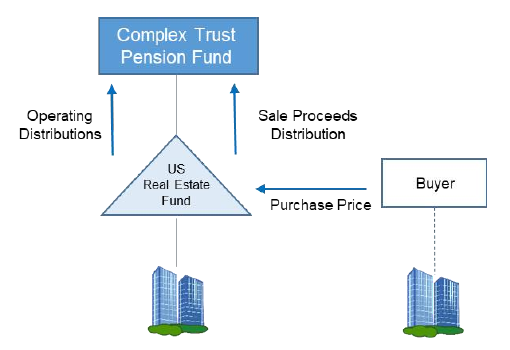
- Net rental income is generally ECI and taxed at 39.6% (with certain special deductions possible).
- Capital gain on sale is also ECI and taxed at 37%.
Example – investment through a leveraged blocker
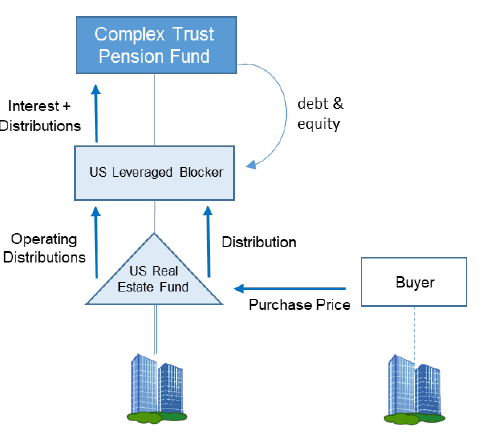
- The blocker is subject to 28% federal tax (plus state) on net rental income and gain on sale of real property.
- Taxable income is reduced by interest expense.
- Interest and dividends paid to the pension fund may be free of (or subject to reduced) withholding tax under a treaty.
- Liquidating distributions from the blocker are not subject to withholding tax (regardless of treaty).
Disclaimer
The information contained herein does not constitute legal or tax advice, may be inaccurate in whole or in part, and may not be relied upon by any person. We disclaim and assume no responsibility for any actions or inaction taken on the basis of the information contained herein.
Contact
Francis J. Helverson, J.D., LL.M. · International Tax Counsel
fhelverson@uslawadvisers.com · +1 201 486 4625