When “No U.S. Real Estate” Can Still Trigger FIRPTA
A case study for foreign institutional investors in U.S. private equity funds
The fund
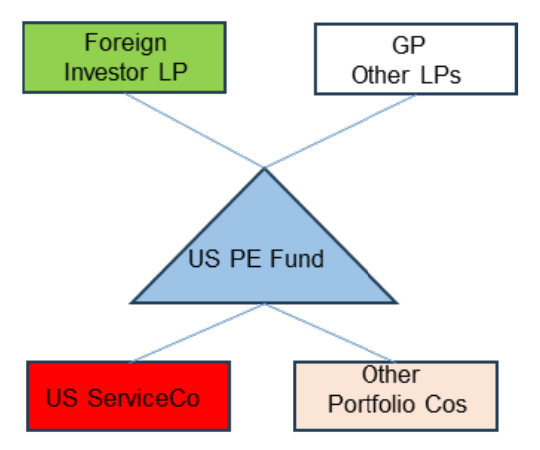
A foreign institutional investor invests in a U.S. private equity fund. During diligence:
- The offering material and other feedback indicate the fund does not intend to invest in U.S. real estate. Instead, the fund will invest primarily in operating companies in the industrial service sector, among other sectors.
- The LPA contains covenants to use reasonable best efforts to avoid income effectively connected with a U.S. trade or business ("ECI") under Internal Revenue Code Section 864(b). This includes ECI arising under IRC Section 897, commonly known as the Foreign Investment in Real Property Tax Act ("FIRPTA"). Blocker entities are contemplated in the LPA to mitigate ECI.
- The investor obtains a side letter providing further ECI comfort.
- The investor proceeds based on the above.
- The investor subscribes and ticks the box to be an "Electing Blocker Partner".
The fund's investment in U.S. ServiceCo
- ServiceCo is engaged in industrial infrastructure services and operates facilities located throughout the United States. Its services include: (i) maintenance and servicing of large equipment; (ii) storage and processing of materials; and (iii) operating specialized service facilities located near major transportation hubs.
- The fund acquires subsequent portfolio companies.
- No blockers are established.
- For Years 1–3 the investor receives IRS Forms K-1 / K-3 showing no ECI.
Everything looks good until Year 4
The investor receives a Year 4 K-1/K-3 package showing modest FIRPTA ECI.
- The investor assumes it is a mistake and requests an explanation from the fund.
- The GP indicates that in connection with its annual audit, ServiceCo was unexpectedly determined to be a U.S. Real Property Holding Corporation ("USRPHC"). This was due to certain assets deemed to be U.S. real property interests ("USRPIs") which had a fair market value that exceeded the fair market value of ServiceCo's other assets.
- A distribution made in Year 4 was partially treated as being gain from a deemed exchange of USRPHC shares – which triggered FIRPTA.
- Full withholding was ultimately made by the fund.
- Nonetheless, the investor is required to file a U.S. federal income tax return, which it has never been required to do in the past. The investor has internal policies prohibiting investments that trigger U.S. tax return filing requirements.
- The tax return filing requirement arises even though no tax is due because the FIRPTA withholding fully satisfied the tax liability.
- The investor is led to believe that ServiceCo will cease to be a USRPHC in the future due to the relative growth in the fair market value of its other business assets.
Upon exit, the five-year lookback rule bites
The investor receives a Year 6 K-1/K-3 package showing substantial FIRPTA ECI relating to the sale of ServiceCo.
- Again, the investor thinks it must be a mistake. Upon inquiry, the GP indicates that it sold the shares of ServiceCo and that even though the relative value of its USRPIs had decreased to below 50% of its total assets, the "5-Year Rule" caused it to be treated as a USRPHC at the time of sale. The fund made proper withholding to the IRS. However, this again triggered a tax return filing requirement for the investor.
- The 5-Year Rule says that stock of a corporation is treated as a USRPI if the corporation was a USRPHC at any time during the previous five years (or the investor's holding period, if shorter). As a result, a sale of the stock can trigger FIRPTA taxation even if the corporation no longer holds significant U.S. real property at the time of the sale.
- The investor learned that if the exit had been structured as an asset sale, the taxable gain would have been recognized at the company level and the liquidation of ServiceCo and distribution of cash to the investor could have been tax-free with no tax return filing requirement. In fact, a buyer in the exit transaction may have preferred an asset deal in part due to the step-up in tax basis that it would achieve.
- The investor also later learned that, unlike for foreign LPs, an asset deal was less favorable from a tax perspective to the GP and many U.S. LPs.
"Insurance planning" through structuring
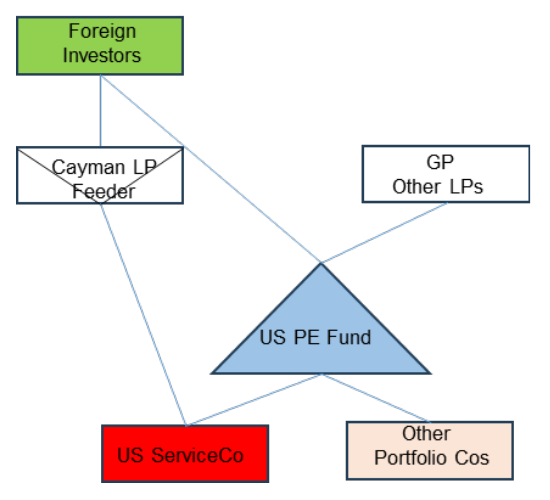
If there is any meaningful risk that a portfolio company could become a USRPHC, the fund could have established a foreign feeder through which foreign investors participate. For example:
- A Cayman Islands limited partnership ("Cayman Feeder") is set up through which foreign investors can elect to invest. Cayman Feeder elects to be treated as a corporation solely for U.S. tax purposes.
- A future sale of ServiceCo would trigger FIRPTA taxation to Cayman Feeder, which would file a U.S. tax return reporting the gain.
- In many European jurisdictions, Cayman Feeder would generally be treated as a pass-through due to its legal status as a limited partnership and treatment as a pass-through in Cayman. This generally means that if ServiceCo were to pay dividends, U.S. treaty benefits may potentially be claimed to reduce the U.S. 30% dividend withholding tax. Thus there may be no loss of treaty benefits with the structure.
- Other countries besides Cayman could also be used.
Prevention through due diligence and side letters
Proactive due diligence
To identify the risk that a PE fund may invest in U.S. portfolio companies that could become USRPHCs:
- Conduct a deeper dive on the sectors in which the fund will invest and consider those in which prior related funds have invested, as well as the sector experience of key persons at the GP level.
- Review the overall composition of investors, especially foreign investors, to help ensure that their tax considerations will be addressed.
- Determine the GP's experience with tax structuring for foreign investors, specifically including FIRPTA mitigation. Consider whether the tax considerations of foreign investors are sufficiently aligned with those of the GP and U.S. LPs.
Additional side letter comfort
- Require the GP to specifically address FIRPTA upon the potential acquisition of a portfolio company that may hold material infrastructure or traditional real estate assets. Valuation fluctuations should be considered from day one to potential exit.
- Require the GP to put in place a feeder structure that mitigates the tax return filing obligation where there is a material risk that USRPHC status could arise.
Disclaimer
This material provides general information and does not constitute legal or tax advice and may not be relied upon. The case study is illustrative.
Contact
Francis J. Helverson, J.D., LL.M. · International Tax Counsel
fhelverson@uslawadvisers.com · +1 201 486 4625